KEY DELIVERABLES FOR MSMEs FROM BUDGET 2019-20

Our economy was at approximately US$ 1.85 trillion when the new government was formed in 2014. Within 5 years it has reached US$ 2.7 trillion. It is the vision of Hon’ble PM Narendra Modi to reach the US$ 5 trillion in the next few years. To achieve this aspirational level, economy aims inclusive growth, especially in the MSME sector. MSME sector in India is growing at an exceptionally fast pace and has truly become the backbone of India’s GDP growth. The role of MSMEs in employment creation, innovation, and encouraging an entrepreneurial spirit has been crucial in fostering competitiveness in the economy and boosting inclusive growth.

KEY DELIVERABLES TO MSMEs:

Hon’ble Finance Minister Nirmala Sitharaman, today announced various measures that will help foster and nurture MSME ecosystem in the country. Here are the key takeaways for MSMEs:

Reduced Tax rate: Lower Corporate Tax rate of 25% benefit widened to all companies with Annual Turnover of INR 400 crores (current limit of INR 250 crores). This will cover almost 99% of companies registered. Such direct incentive will big boost SME Segment. This will enable MSMEs to increase its scale of business and expand its existing markets more competitively. MSMEs can now focus on Research and Development, Quality Assurance and develop competencies which will ensure their growth in long run. Such direct incentive will big boost to SME segment in creation of jobs across sectors as MSMEs are the largest employers in the country.

 Lower Interest burden: Interest Subvention Scheme for MSMEs, INR 350 crore has been allocated for FY 2019-20 for 2% interest subvention for all GST registered MSMEs, on fresh or incremental loans.

 Elimination of multiple Labour Laws compliances: Consolidation of multiple labour laws into a set of limited 4 labour codes to reduce compliances.

GST filing made simpler: Taxpayer having annual turnover of less than 5 crore shall be required to file quarterly return (currently monthly returns are required to be filed); Free accounting software for return preparation will be made available to small businesses.

Ease of doing business: Creation of a payment platform for MSMEs to enable filing of bills and payment to avoid the delays in Government payments to suppliers and contractors.

 Promoting cashless economy: 2 % TDS on cash withdrawal exceeding INR 1 crore in a year from bank account to discourage cash transactions

Breather for Startups: For the purpose of Angel Tax, no Income Tax Scrutiny will be initiated on valuation of share issued for startups. Identification of Investors in Startups will also stop. Further, Pre approval is required to be taken by Assessing Officer from higher authorities for assessment of startups.

CONCLUSION:

MSME sector is a strong vehicle for inclusive growth, creating local demand and consumption and is the fountain head of several innovations, especially in the manufacturing and service sectors. This budget would give huge boost to MSMEs with introduction of MSME loan in 59 minutes, interest subvention schemes, reduction in corporate tax rates, creating payment platform and like initiatives

The Budget has taken into consideration the broader perspective towards the concerns of MSMEs. It has managed to achieve the spectrum – rural and infra sectors, MSMEs – while focussing with fiscal consolidation. Finance Minister has struck a fine balance between the needs of growth, social development, and investor confidence. SMEs will have to embrace the digital economy to explore the benefits accruing in the form of enhanced competitiveness, improved productivity, credit based on transaction history and greater transparency in their businesses.

“The announcements made in the Budget reflect that government of India seems very firm in reviving the MSME sector and aims to lessen the hardships of the entrepreneurs. SME sector has been assured with required policy support, incentive programs which will provide them necessary economic hand holdings. Strengthened MSME sector would also lend further boost to employment generation. With this, SME Sector is all set to get digital, explore the growth opportunities and become the driver for growth of the Indian economy.”

Overall Budget is assuring a hopeful future for struggling SMEs to outperform their competencies and explore wider avenues of business. Union Minister was successful in presenting a positive Budget; comforting SMEs to overcome their shortcomings. The strengthening of these businesses would play a critical role in India’s transition to becoming an economic superpower.
SEBI’s New Liquid Fund Rules Explained: Lower Returns and Risk!

On June 27th 2019, the SEBI board approved several proposals to manage risk and liquidity in liquid mutual funds. Over a period of time, it will lower risk and therefore returns in this space. Here is a simple explanation of what these rules mean to the investor.

The proposals were made by the Mutual Fund Advisory Committee to address the increase in liquidity risk due to credit events and approved by the SEBI board. Let us go over each of these.Liquid Schemes shall be mandated to hold at least 20% in liquid assets such asCash, Government Securities, T- bills and Repo on Government Securities

Pro: This is an excellent move to ensure enough liquidity when there is a redemption crisis like in 2008 or 2013. The AMCs can handle institutional redemptions a little better.

Pro: Credit risk profile of the portfolio will be lower

Con: Returns will be a bit lower. In the bond space, you cannot eat your cake and have it too. You cannot get higher returns if you reduce credit risk. By construction, a risky bond must fetch a higher interest.

The cap on the sectoral limit of 25% shall be reduced to 20%. The additional exposure of 15% to HFCs shall be restructured to 10% in HFCs and 5% exposure in securitized  debt based on retail housing loan and affordable housing loan portfolios

Pro: Will reduce concentration risk, this is only with respect to daily volatility. If there is a credit event, the impact will be pretty much the same. Securitized debt is a composite bond created by pooling different types of bonds together. It will improve the liquidity of the underlying bonds but is susceptible to credit risk (remember the Jenga blocks from the movie, the big short?)Of course, the credit risk, in this case, is a lot lower (as the duration is shorter), however, 25% cap or 10% cap does not matter if the fund manager is unable to sell degraded bonds. See for example DHFL Crisis: Did UTI Mutual Fund act in the interest of investors? If there is a credit event, 10% exposure will feel the same as a 20% exposure.

The valuation of debt and money market instruments based on amortization shallbe dispensed with completely and shall be based on mark to market (MTM)

When we buy a bond, we receive interest payments periodically and the principal back when the tenure ends. These cash flow events over a period of time can be represented by a “smooth” increase in the value of our investment. This is referred to as a bond amortization which assumes a value for the purchased bond.Over the past few years, SEBI mandated that bond amortization is applicable only for 91 days bonds, and then reduced it further to 60 days and then to 30 days. Now it is pretty much zero. Meaning, bond amortization has been done away.

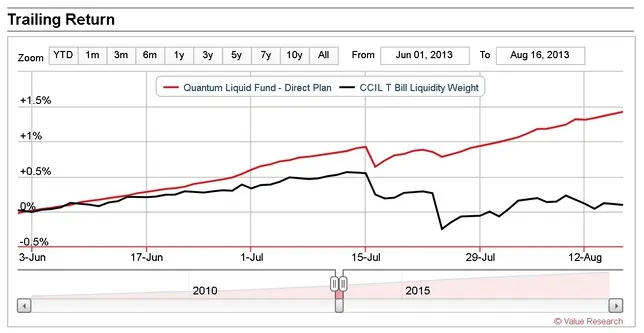
Pro: Thus the value of the bond will be equal to its market value. Meaning liquid fund NAV will no longer increase smoothly. While this might seem like a bad development, it is actually healthy as it will reflect true market developments. A bond that has degraded will show up as a small dip in NAV. This does not, of course, mean the fund managers will sell it (assuming they can!), but at the very least investors will become more sensitive to credit rating changes.The increased volatility is nothing to be worried about.  Quantum Liquid Fund [one of the safest funds out there, see: My Handpicked Mutual Funds April 2019 (PlumbLine)] has always been MTM based. Since it invests in safe assets, it does not show up (other than during severe events like July 2013 (see the screenshot from Value Research)

Quantum Liquid Marketed to Market Example

Liquid and overnight schemes shall not be permitted to invest in Short Term Deposits, debt and money market instruments having structured obligations or credit enhancements.

Pro: These are bonds where a third party aids the borrower with debt repayment can be troublesome as the true creditworthiness of the borrower is buried under the credit rating of the arrangement.  Removing these from liquid and debt funds will improve their credit profile.For other schemes, the overall limit in such instruments is 10% and not more than 5% from a particular issuer. This should be backed by a security cover of at least four times the investment backed by equities directly or indirectly. This will reduce concentration risk and credit risk to some extent.

A graded exit load shall be levied on investors of liquid schemes who exit the scheme up to a period of 7 days.

Pro: This will marginally help the liquidity of liquid funds. 

Con: (for the AMC, not investor) Big players will prefer liquid funds.

Mutual Fund schemes shall be mandated to invest only in listed NCDs and the same would be implemented in a phased manner. All fresh investments in Commercial Papers (CPs) shall be made only in listed CPs pursuant to the issuance of guidelines by SEBI in this regard

This (applicable to all schemes, not just liquid) will not have much of an impact on credit risk and will make liquid funds truly MTM.

Summary

Overall this is a step in the right direction. Liquid fund portfolios will now be more healthy. The NAV will be more volatile but at least it will reflect credit rating changes faster and caution investors. Liquid funds are for parking money and not for generating returns. As long as investors keep this mind, they should be fine.

Five Golden Rules For Stock Trading success

When you start out day trading or if you are planning to get into it, the first thing that you might have heard is that many traders lose money. You may wonder, ‘Can anybody become a successful trader?’ After all, most people who try, fail. I believe the short answer is, yes, there is one hundred percent chance that each of us out there can pull this off. The long answer is, yes, you make it to the list of successful traders but there is one small caveat, ‘You have to want to be successful’. Hang on! You might wonder; don’t we all wish to be a successful trader?

Perhaps, you do not just become a successful trader because you ‘want to’. You become one because you have the right methodology which provides you with an edge above the rest.

Our team has put together a crisp, to the point, white paper that will provide you with the Five Golden Rules For Stock Trading Success, that will help you get better at trading.

Here’s the ‘ultimate secret’ to get started on the path to becoming the best trader you can be.

Union Budget 2019 – Simplified

The Hon’ble Finance Minister, Ms Nirmala Sitharaman presented the Union Budget 2019. 

The Budget focused majorly on the following :

  • Infrastructure Development
  • Resilient Financial System
  • Skill Development & Job Creation
  • MSME growth conductivity
  • Incentivising Start-Ups
  • Resolving Liquidity & Credit Delivery of NBFCs & PSUs
  • Environment conservation
  • Women Entrepreneurship
  • Tax regulatory changes

We have simplified the Budget and happy to share the copy of “Union Budget 2019 – Simplified” for your reference and reading.