
On June 27th 2019, the SEBI board approved several proposals to manage risk and liquidity in liquid mutual funds. Over a period of time, it will lower risk and therefore returns in this space. Here is a simple explanation of what these rules mean to the investor.
The proposals were made by the Mutual Fund Advisory Committee to address the increase in liquidity risk due to credit events and approved by the SEBI board. Let us go over each of these.Liquid Schemes shall be mandated to hold at least 20% in liquid assets such asCash, Government Securities, T- bills and Repo on Government Securities
Pro: This is an excellent move to ensure enough liquidity when there is a redemption crisis like in 2008 or 2013. The AMCs can handle institutional redemptions a little better.
Pro: Credit risk profile of the portfolio will be lower
Con: Returns will be a bit lower. In the bond space, you cannot eat your cake and have it too. You cannot get higher returns if you reduce credit risk. By construction, a risky bond must fetch a higher interest.
The cap on the sectoral limit of 25% shall be reduced to 20%. The additional exposure of 15% to HFCs shall be restructured to 10% in HFCs and 5% exposure in securitized debt based on retail housing loan and affordable housing loan portfolios
Pro: Will reduce concentration risk, this is only with respect to daily volatility. If there is a credit event, the impact will be pretty much the same. Securitized debt is a composite bond created by pooling different types of bonds together. It will improve the liquidity of the underlying bonds but is susceptible to credit risk (remember the Jenga blocks from the movie, the big short?)Of course, the credit risk, in this case, is a lot lower (as the duration is shorter), however, 25% cap or 10% cap does not matter if the fund manager is unable to sell degraded bonds. See for example DHFL Crisis: Did UTI Mutual Fund act in the interest of investors? If there is a credit event, 10% exposure will feel the same as a 20% exposure.

The valuation of debt and money market instruments based on amortization shallbe dispensed with completely and shall be based on mark to market (MTM)
When we buy a bond, we receive interest payments periodically and the principal back when the tenure ends. These cash flow events over a period of time can be represented by a “smooth” increase in the value of our investment. This is referred to as a bond amortization which assumes a value for the purchased bond.Over the past few years, SEBI mandated that bond amortization is applicable only for 91 days bonds, and then reduced it further to 60 days and then to 30 days. Now it is pretty much zero. Meaning, bond amortization has been done away.
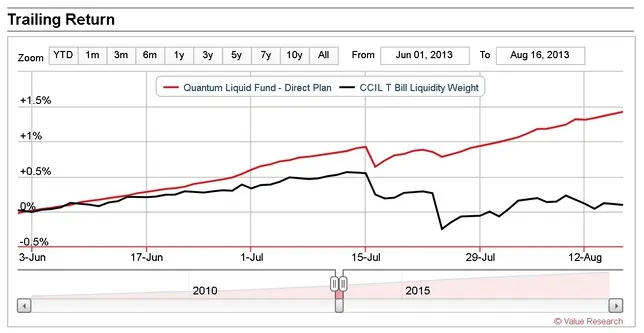
Pro: Thus the value of the bond will be equal to its market value. Meaning liquid fund NAV will no longer increase smoothly. While this might seem like a bad development, it is actually healthy as it will reflect true market developments. A bond that has degraded will show up as a small dip in NAV. This does not, of course, mean the fund managers will sell it (assuming they can!), but at the very least investors will become more sensitive to credit rating changes.The increased volatility is nothing to be worried about. Quantum Liquid Fund [one of the safest funds out there, see: My Handpicked Mutual Funds April 2019 (PlumbLine)] has always been MTM based. Since it invests in safe assets, it does not show up (other than during severe events like July 2013 (see the screenshot from Value Research)
Liquid and overnight schemes shall not be permitted to invest in Short Term Deposits, debt and money market instruments having structured obligations or credit enhancements.
Pro: These are bonds where a third party aids the borrower with debt repayment can be troublesome as the true creditworthiness of the borrower is buried under the credit rating of the arrangement. Removing these from liquid and debt funds will improve their credit profile.For other schemes, the overall limit in such instruments is 10% and not more than 5% from a particular issuer. This should be backed by a security cover of at least four times the investment backed by equities directly or indirectly. This will reduce concentration risk and credit risk to some extent.
A graded exit load shall be levied on investors of liquid schemes who exit the scheme up to a period of 7 days.
Pro: This will marginally help the liquidity of liquid funds.
Con: (for the AMC, not investor) Big players will prefer liquid funds.
Mutual Fund schemes shall be mandated to invest only in listed NCDs and the same would be implemented in a phased manner. All fresh investments in Commercial Papers (CPs) shall be made only in listed CPs pursuant to the issuance of guidelines by SEBI in this regard
This (applicable to all schemes, not just liquid) will not have much of an impact on credit risk and will make liquid funds truly MTM.
Summary
Overall this is a step in the right direction. Liquid fund portfolios will now be more healthy. The NAV will be more volatile but at least it will reflect credit rating changes faster and caution investors. Liquid funds are for parking money and not for generating returns. As long as investors keep this mind, they should be fine.